
Unforgettable Ostriches
“It seems to me that the natural world is the greatest source of excitement; the greatest source of visual beauty; the greatest source of intellectual interest. It is the greatest source of so much in life that makes life worth living.”
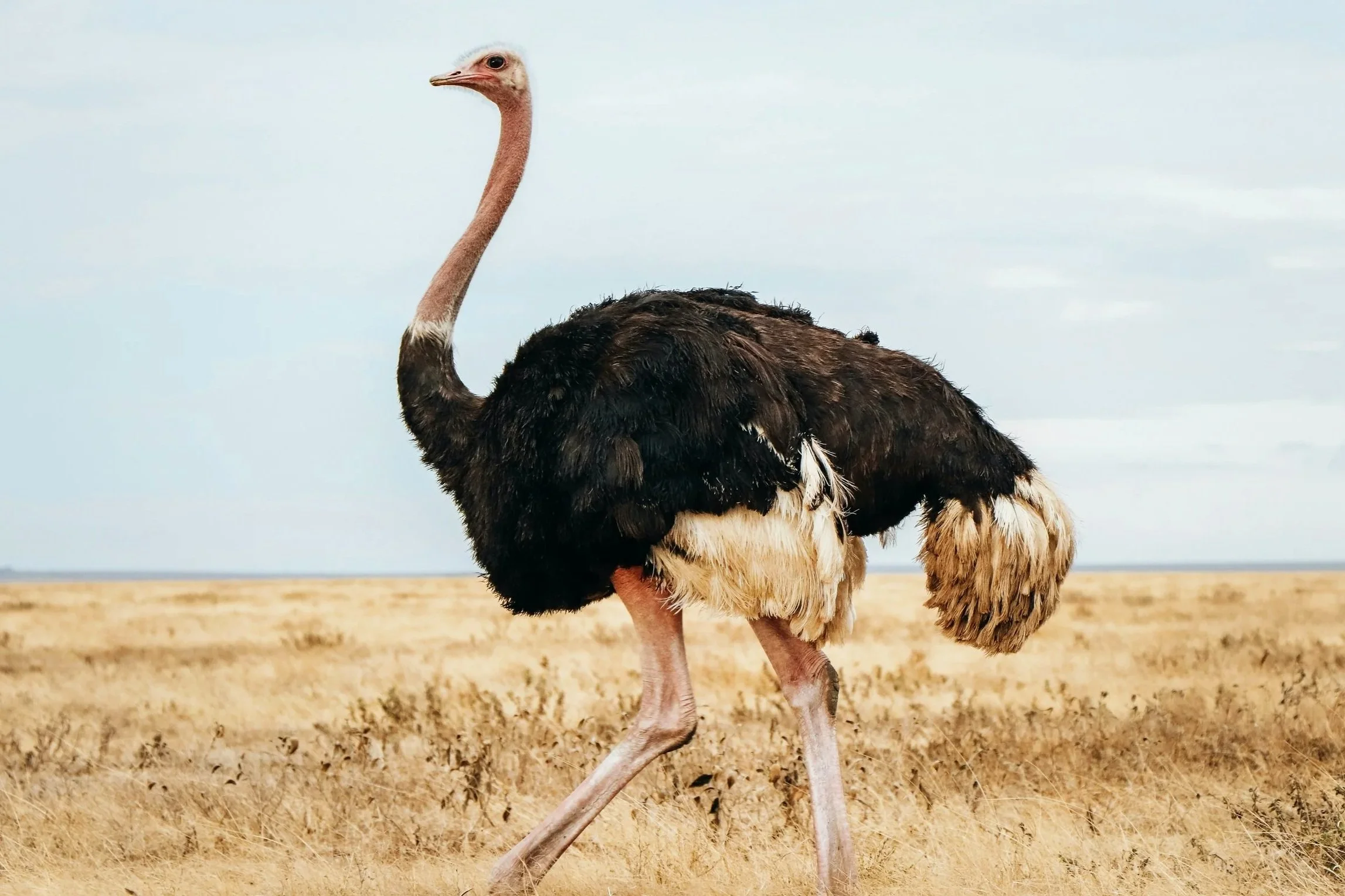
From their incredible speed to their unusual family life and dramatic courtship displays, ostriches are super fascinating to observe on safari - and not just because of their size.
Photo Credit to Team Mfina
Amazing Facts About Ostriches
They're the world's largest living birds. Ostriches can stand more than 8 feet tall and weigh well over 200 pounds, yet they have incredibly long, powerful legs built for running rather than flying.
They are seriously fast. Ostriches can reach speeds of around 40–45 mph and can maintain a fast pace over considerable distances. Their long legs also allow them to cover several meters with each stride, making an ostrich running across the Serengeti an impressive sight.
Their eyes are enormous. An ostrich has exceptionally large eyes—among the largest of any land animal relative to its body size. Excellent eyesight is crucial on the open plains, where spotting predators from a distance can mean the difference between escape and becoming a meal.
They don't need to fly to escape danger. Their powerful legs are their primary defense, and an ostrich can deliver a formidable kick if cornered. Their long legs also make them surprisingly agile despite their size.
Their eggs are enormous. An ostrich egg is the largest egg laid by any living bird and can weigh around three pounds. In the Serengeti, nests can contain eggs contributed by multiple females, with researchers documenting clutches of up to 38 eggs.
The parents have an unusual parenting system. Several females may lay their eggs in a shared nest, while the dominant male and a principal female take leading roles in incubation and care. The arrangement means that an ostrich nest can become a communal nursery.
Males become dramatically more colorful during breeding season. The normally dark male ostrich can develop striking red or pink coloration on the neck and legs during breeding season as hormones influence pigmentation.
Rainfall influences their family life. In the Mara–Serengeti ecosystem, ostrich breeding is closely connected to rainfall and food availability. Research found a major breeding peak around February and a smaller peak around October, with larger ostrich groups during wetter periods.
Ostriches Are So Much Fun to Watch
Ostriches have a wonderful combination of size, personality, and surprisingly dramatic behavior that makes them entertaining safari subjects.
Watch a group moving across the plains and you may see them suddenly break into a run, bob their heads as they forage, or stop to investigate something in the distance. Their exaggerated movements and towering height make them easy to spot—and when an ostrich decides to run, the sheer speed of such a huge bird can be astonishing.
Breeding season can make sightings even more entertaining. Males perform elaborate displays to attract females, and their normally subdued coloring can become much more striking. With experienced Moyo guides behind the wheel, guests can learn to recognize these behaviors and understand what they're seeing rather than simply passing by another large bird.
And then there are the chicks. Baby ostriches are extremely adorable, covered in soft, striped down that provides camouflage against the grass. Seeing an adult pair accompanied by a group of chicks is one of those wonderfully unexpected safari sightings.
Ostriches Sightings Year Round
January – March: The green season and the major ostrich breeding peak around February can make this an exciting period for watching breeding behavior, groups, and potentially chicks.
April – May: The long rains bring lush vegetation and dramatic skies. This can be a beautiful time for photography, and wetter conditions are associated with larger ostrich groups.
June – October: Drier conditions generally mean more open visibility, making it easier to spot these enormous birds against the grasslands. This is also the period when the northern Serengeti becomes especially important for the Great Migration and can be combined with outstanding broader wildlife viewing.
November – December: The short rains bring fresh green growth back to much of the Serengeti. Moyo's Warangi and Hembe camps offer access to the central Serengeti during this period, when landscapes become greener and herds begin moving south again.
The Ostrich Experience at Moyo's Camps
Moyo Camp Hembe's commanding views across the open plains create an excellent setting for spotting large, easily visible birds like ostriches.
The open landscape gives guests the opportunity to watch ostriches from a distance as they forage, move between grazing areas, or stride across the horizon. During the wetter months, when grasses are greener and ostriches may gather in larger groups, the landscape can feel particularly vibrant. Research in the Mara–Serengeti ecosystem found that ostrich groups tend to be larger during wet periods than during the dry season.
Hembe's central location also makes it possible to experience changing seasonal wildlife patterns without relying on a single migration event.
Moyo Camp Warangi sits in the Seronera Valley beside the Warangi River, where permanent water sources contribute to year-round game viewing.
Here, an ostrich sighting can become part of a broader central Serengeti game drive, with opportunities to encounter resident wildlife alongside predators and seasonal visitors. During wetter periods, look for ostriches moving through the greener landscape, while the drier months can provide excellent visibility across open areas where these tall birds are difficult to miss.
Warangi is also a wonderful place to let your guide help you read the landscape. An ostrich suddenly becoming alert or changing direction can be a clue that it has spotted something interesting long before you have.
Moyo Migration Camp Mara provides a different perspective from the northern Serengeti, with a permanent camp that allows guests to experience the region throughout the year.
Here, ostriches become part of the northern Serengeti's diverse wildlife experience. During the migration months, the landscape can become particularly dynamic as enormous herds move through the region, while resident species such as ostriches remain part of the ecosystem.
The northern Serengeti also offers a fascinating seasonal contrast: the dry months bring excellent visibility across the plains, while the return of rain transforms the landscape with fresh vegetation and renewed activity.

Because ostriches are residents of the Serengeti ecosystem rather than migration-dependent animals, sightings can be part of a safari from all three of Moyo Tented Camp’s award-winning locations.
Photo Credit to Wolfgang Hasselmann
Let’s plan your safari, itinerary, and special wishes.